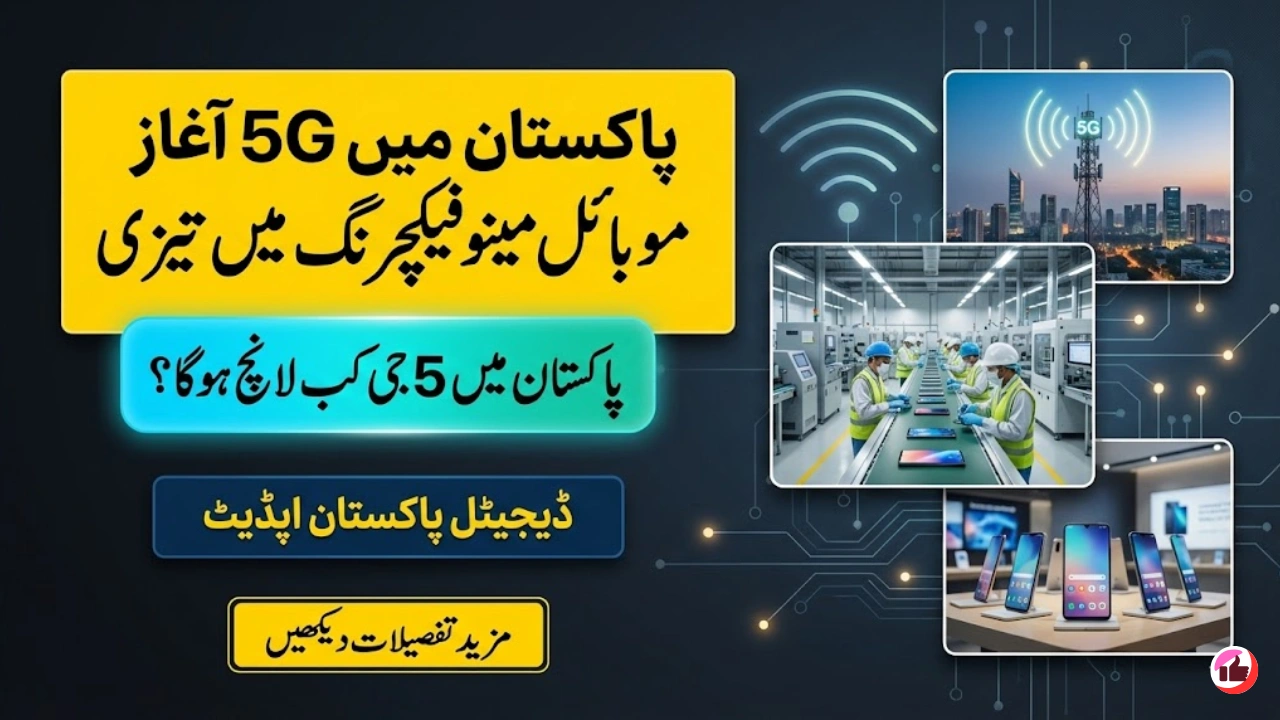
Pakistan is moving closer to the commercial launch of 5G services, and this shift is already reshaping the country’s mobile phone manufacturing landscape. With policy signals pointing to a mid-year rollout, local handset makers are gearing up to meet the next wave of consumer demand—without abandoning affordability.
Punjab-Backed Industry Readiness for 5G Era
Pakistan’s mobile manufacturing sector has expanded rapidly over the last few years. More than 30 local assembly and manufacturing units are now active, collectively producing nearly 30 million handsets every year. This strong base gives local players the flexibility to transition from 4G to 5G-ready devices as networks come online.
Industry insiders say that most manufacturers have already adjusted their production plans and hardware designs to align with next-generation mobile services.
Local Manufacturers Aligning with 5G Technology
According to Inovi Telecom, local assembly capabilities have matured enough to support advanced technologies. Manufacturers have begun integrating support for key 5G frequency bands into newer smartphone models, ensuring readiness once spectrum allocation and network rollout are completed.
However, the pace of growth will largely depend on regulatory clarity, timely spectrum auctions, and how smoothly telecom operators deploy their networks across the country.
Eligibility: Who Will Benefit First from 5G Phones?
The early benefits of 5G-compatible devices are expected to be seen mainly in:

-
Urban consumers in major cities
-
Users upgrading from mid-range to premium smartphones
-
Businesses relying on high-speed mobile connectivity
At present, most 5G-enabled smartphones assembled or sold locally fall into the mid-to-high price segment, with prices starting around Rs75,000.
Benefits for Pakistan’s Mobile Industry
The upcoming 5G rollout offers multiple advantages:

-
Boost in local handset manufacturing and employment
-
Reduced reliance on imported finished devices
-
Faster adoption of advanced mobile applications
-
Stronger ecosystem for digital services and startups
Manufacturers believe that gradual demand growth will help stabilize prices over time.

Limitations and Market Challenges
Despite strong preparation, some challenges remain:
-
High initial cost of 5G-enabled smartphones
-
Price sensitivity among a large segment of consumers
-
Dependence on timely spectrum allocation
-
Gradual, city-focused network rollout

To address this, companies plan to continue offering affordable 4G devices alongside newer 5G models.
Applying Process: How Manufacturers Are Preparing
Local brands are following a phased approach:
| Step | Industry Action |
|---|---|
| Hardware planning | Aligning chipsets with 5G bands |
| Production | Upgrading assembly lines gradually |
| Market strategy | Launching 5G models alongside 4G |
| Pricing | Balancing affordability with features |
This strategy allows manufacturers to stay competitive while minimizing risk.
Will 5G phones be affordable in Pakistan soon?
Prices are expected to come down gradually as demand increases and local production scales up.
Are locally assembled phones already 5G-ready?
Some models support 5G bands, but most are currently in mid-to-high price ranges.

Will 4G phones disappear after 5G launch?
No, manufacturers will continue producing 4G devices for budget-conscious users.
Which areas will see 5G first?
Early adoption is likely in major urban centres before expanding nationwide.Final Thoughts
Pakistan’s 5G rollout is more than a telecom upgrade—it’s a catalyst for local mobile manufacturing growth. With strong assembly capacity, careful planning, and a balanced product mix, local handset makers are positioning themselves to benefit from next-generation connectivity while keeping affordability in focus. As networks expand and prices stabilize, the impact of 5G on Pakistan’s digital economy is set to grow steadily.